Digital Antiquity
has partnered with the
Society for American Archaeology
to preserve the 2019 annual meeting abstracts and make the presentations and
data used to support them available in tDAR. As a
presenter you can access your record in tDAR, edit the metadata, and upload a
PDF copy of your paper, presentation, poster, or other supplementary data (up
to 3 files/30MB), and it’s FREE. Here’s
how to get started:
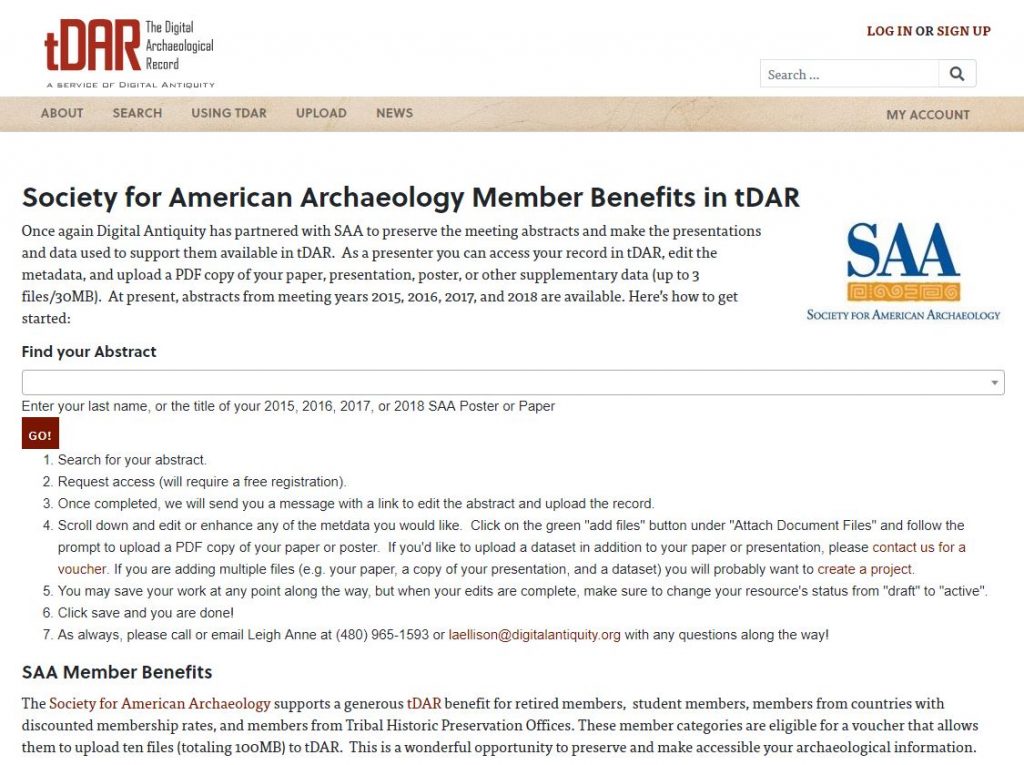
Search for your abstract by typing your name or abstract title in the box.
Fill out the message box to request access to your paper’s abstract (you will need to register – but that’s free).
Once completed, we will send you a message within one business day with a link to edit your abstract and upload the paper or poster.
Were you an SAA presenter in 2018 (Washington
D.C.), 2017 (Vancouver), 2016 (Orlando), or 2015 (San Francisco) but haven’t
uploaded your presentation yet? Not to worry – those abstracts are also in
tDAR. Help other researchers find and cite your SAA presentations by making
them available today!
Additionally, the tDAR SAA Member
Benefit allows retired members, student members, members from countries with
discounted rates, and members from Tribal Historic Preservation Offices to
upload ten files (up to 100MB) annually to tDAR. Contact membership@saa.org to request your voucher.
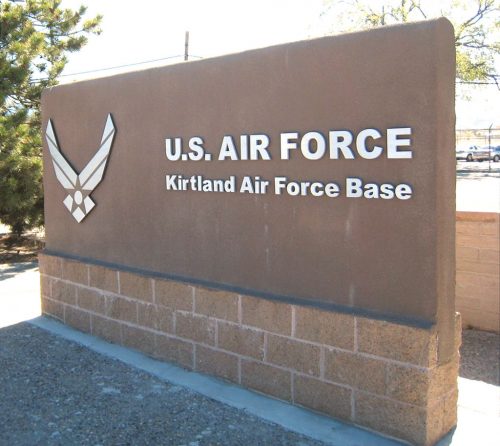
Last week, our Senior Digital Data Curator, Rachel Fernandez, was out on the road again to present at the 2019 Air Force Cultural Resource Workshop, held at the Kirtland Air Force Base in Albuquerque, New Mexico. Sponsored by theAir Force Civil Engineer Center (AFCEC), the three-day workshop included natural and cultural resource managers from Air Force installations spread across the states to discuss issues and developments in cultural resource management within the Air Force.
One of the ongoing projects discussed at the meetings was the Center for Digital Antiquity and AFCEC’s collaboration to preserve Air Force cultural resources within tDAR. At present, there are over 500 active resources within tDAR from over 17 different installations, with another 2500 resources in different stages of completion. At this meeting, Rachel was able to provide training on the tDAR system and answer questions concerning organizing and managing digital resources.
We hope to continue being involved in these workshops and
work closely with AFCEC to provide digital curation and preservation services
for the US Air Force.
The ARIADNEplus project invites archaeological researchers and data managers to participate in an online survey on community needs regarding data sharing and access, new services and tools, and related training needs.
ARIADNEplus,is a project funded by the European Commission under the Horizon 2020 Programme. It aims to integrate archaeological datasets in a digital infrastructure so that researchers can use them with services and tools which will also be provided by the project.
We kindly invite you to share your experience and your views on the survey topics. Please note that the survey includes matrix table questions, therefore using a desktop or notebook (not a tablet or mobile) is recommended.
Earlier this year the Board of the American Cultural Resources Association (ACRA) @acracrm endorsed and posted on the ACRA website two important documents promoting the sharing of data (e.g., reports and other documents, images, data sets, and other kinds of digital files) among archaeologists and other cultural resource specialists in CRM, academic and museum positions, public agencies, and other organizations. One is a three-page policy document focused on promoting greater synergy between academic professionals and the CRM industry. The document, which stresses the benefits of and need for greater communication and collaboration, presents recommendations of an ACRA task force, led by Duane Peter, that worked on the issue. The second document, “Digital Data Curation and Access: Why You and Your Organization should be Actively Involved”, summarizing the reasons for and benefits of greater sharing of data.
Additional publications concerning digital archaeology and data curation, including reports, case studies, and other helpful materials, can be found on the Digital Antiquity Publications page.
Digital Antiquity staff and Board of Directors members were out in force at the 84th Annual Meeting of the SAA in Albuquerque, New Mexico.
With the
highest attendance the SAA has seen – over 5,300 attendees! – the 4-day
conference was filled with various meetings, sessions, and discussions with
people at the exhibitor booth.
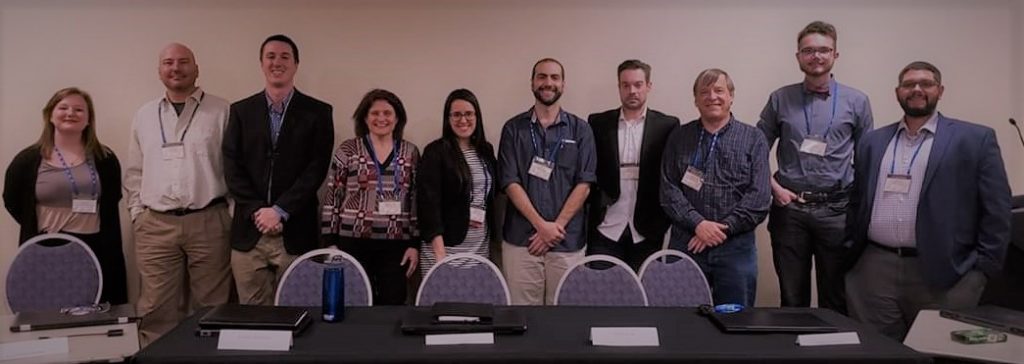
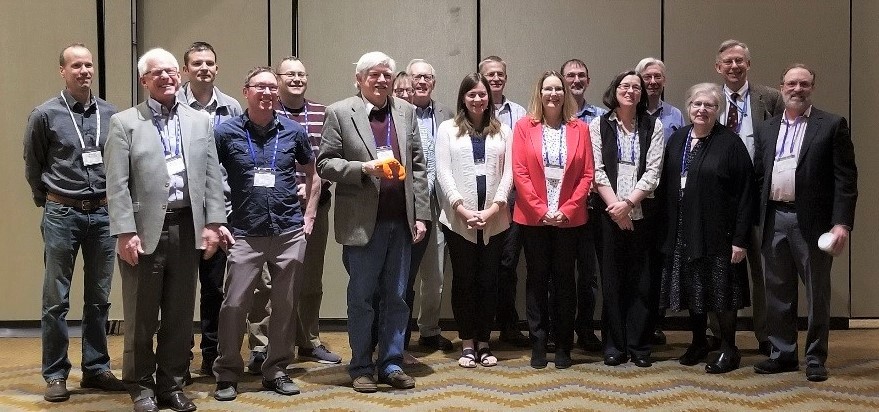
Rachel Fernandez with the Electric Symposium Group
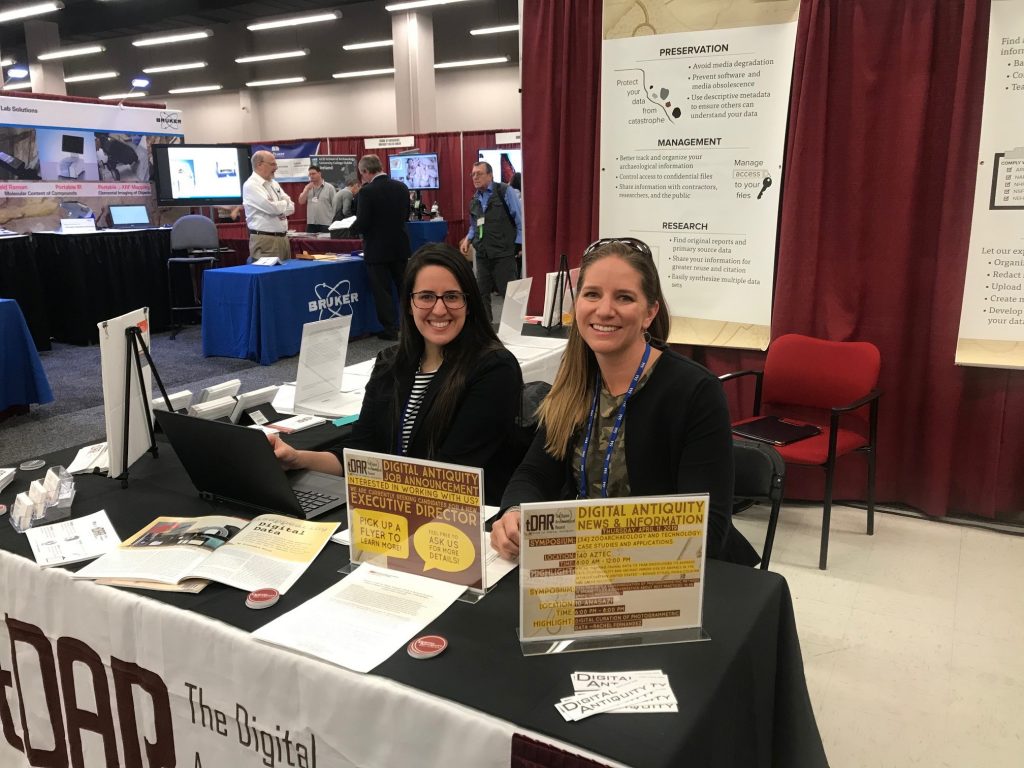
Rachel Fernandez and Leigh Anne Ellison at the SAA tDAR Booth
Between the Digital Antiquity staff alone, we participated in over four sessions, sat on two committee meetings, lead a hands-on Digital Curation workshop, and spent countless hours at the exhibitor hall discussing the benefits and uses of tDAR.
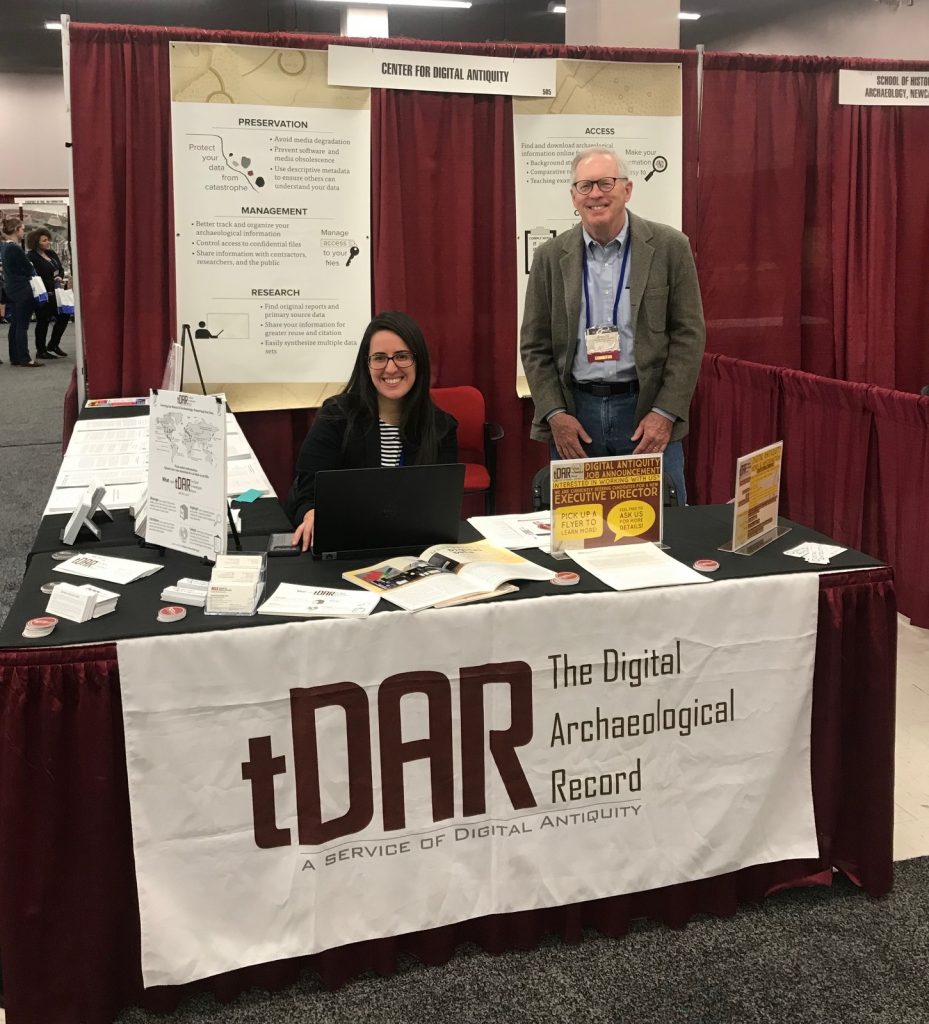
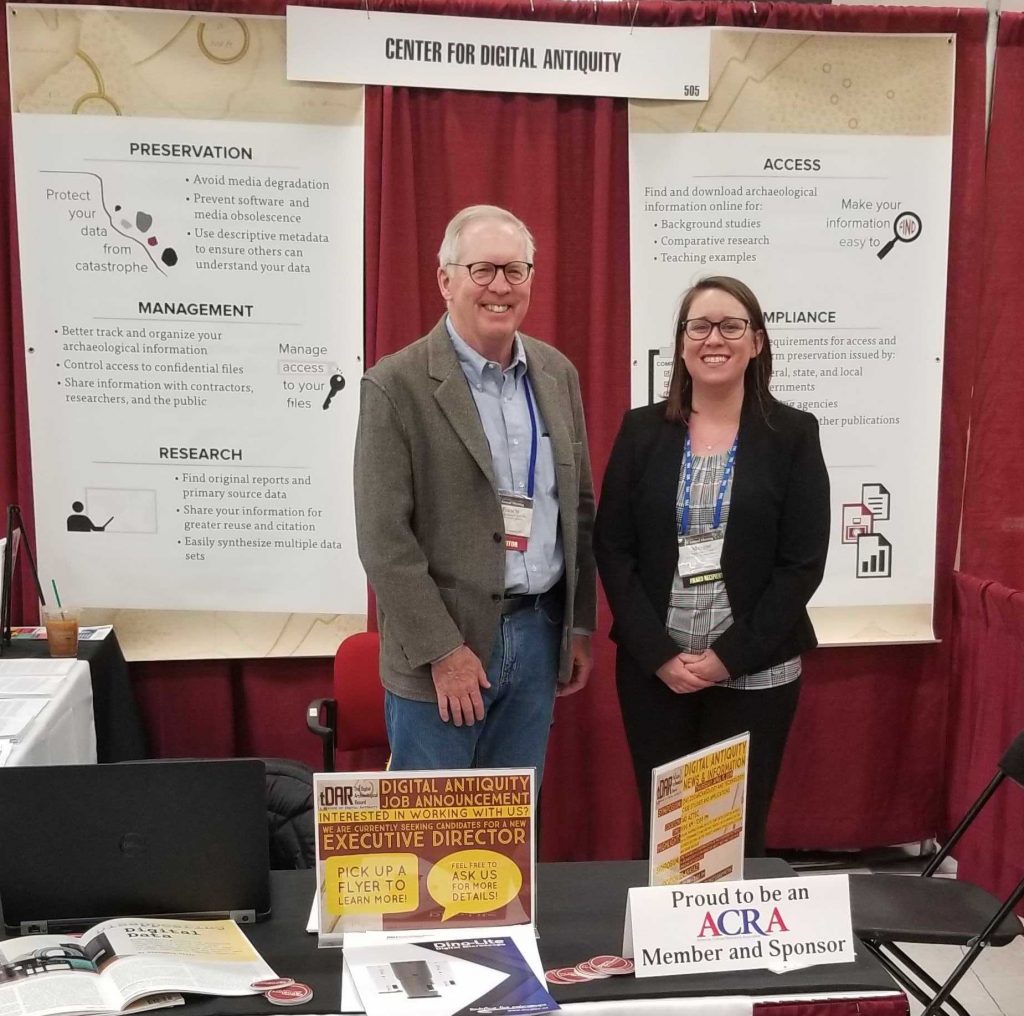
Dr. Frank McManamon and Rachel Fernandez at the SAA tDAR booth
The tDAR Booth was visited by Meagan Dennison, Winner of the 2019 SAA Student Paper Award! As part of her prize, Digital Antiquity provided Meagan with 50 Files (up to 525 MB!) of repository space in tDAR to preserve and share her current and future research.
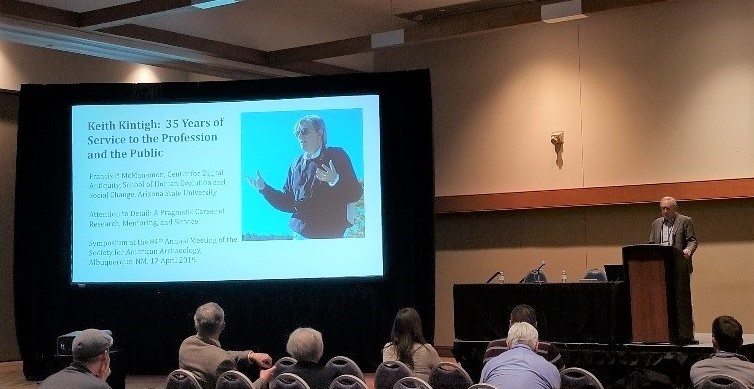
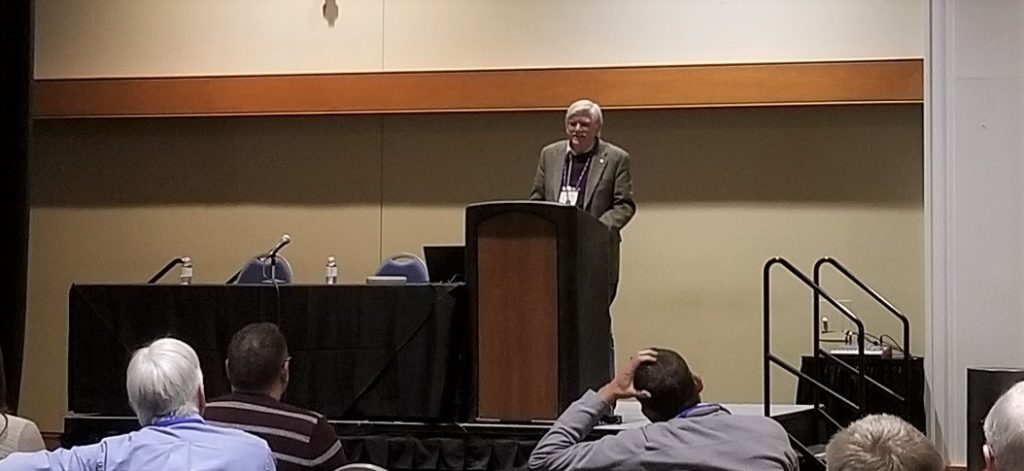
A meeting highlight of particular note was the Symposium 188, “Attention to Detail: A Pragmatic Career of Research, Mentoring, and Service, Papers in Honor of Keith Kintigh” in which our own Dr. Kintigh was recognized for his considerable contributions to the field of archaeology and advocacy for digital preservation. Among the speakers lauding Dr. Kintigh’s accomplishments were tDAR’s Founding Director Dr. Frank McManamon and Digital Antiquity Board Member, Jeffrey Altschul, further marking the session as a truly special event.
Dr. Keith Kintigh was recognized by his peers, colleagues, and mentees at the SAA Meeting
Dr. Frank McManamon speaking at Dr. Keith Kintigh’s SAA Symposium
Dr. Keith Kintigh Speaking at his SAA Symposium
Utilizing your SAA-Digital Antiquity
Good Digital Curation Agreement Benefits
In order to
preserve and readily share the incredible work of SAA Meeting presenters, the
Center for Digital Antiquity has continued its Good Digital Curation Agreement
partnership with the SAA, now into its fifth year. Through this partnership,
all session abstracts from past conferences (2015-present) can be found on the
tDAR website. Further, if you are the
author of an abstract(s), you can utilize your SAA Member Benefits to upload
your presentation, paper, poster, or other supplementary data into tDAR for
free (up to 30MB).
In addition to presenter benefits, the SAA also supports up to 10 free uploads (totaling 100MB) into tDAR for retired members, student members, members from countries with discounted membership rates, and members from Tribal Historic Preservation Offices.
Preserving and making your archaeological data accessible has never been easier! We hope you will take advantage of this opportunity to enrich future research by uploading your archaeological information into tDAR. You can find your abstract and learn more about your SAA benefits here: https://www.tdar.org/saa
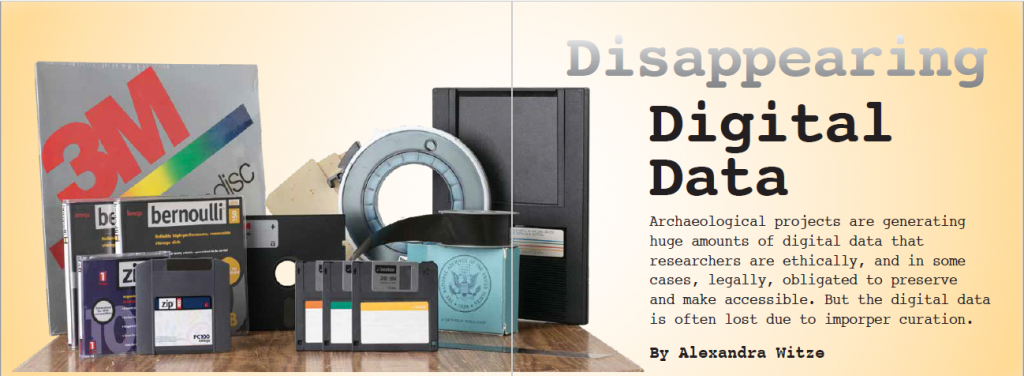
Recently, ASU archaeology Professor Keith Kintigh and Founding Director Frank McManamon were interviewed by Alexandra Witze, a writer for the Archaeological Conservancy’s “American Archaeology” Magazine. The Archaeological Conservancy is a non-profit organization whose mission is to identify, acquire and preserve significant archaeological sites in the U.S. That mission dovetails nicely with our mission at Digital Antiquity: to acquire, preserve and make accessible the digital data associated with archaeological research. In the article, Frank and Keith recount the urgent need to upload digital archaeological data to repositories like tDAR.
Most archaeologists aren’t curating their digital data at public repositories like tDAR. Kintigh stressed that proper curation is more important than ever because now much of this information is, so to speak, “born digital” and exists in no other form. Without it, future generations of scientists won’t be able to reanalyze and synthesize the information and make fresh discoveries of their own. “It’s a tragedy that we’re not adequately capitalizing on the potential uses of the data,” he said.
This follows on the heels of a forthright article by Keith last fall in “The Conversation,” where he argued strongly that “agencies must ensure that the full digital record of their archaeological investigations is deposited in a recognized digital repository.” tDAR has worked effectively with a number of agencies (Dept. of Defense, Bureau of Land Management, and the Bureau of Reclamation, among others) to make archaeological information discoverable, accessible and preserved permanently for future use.
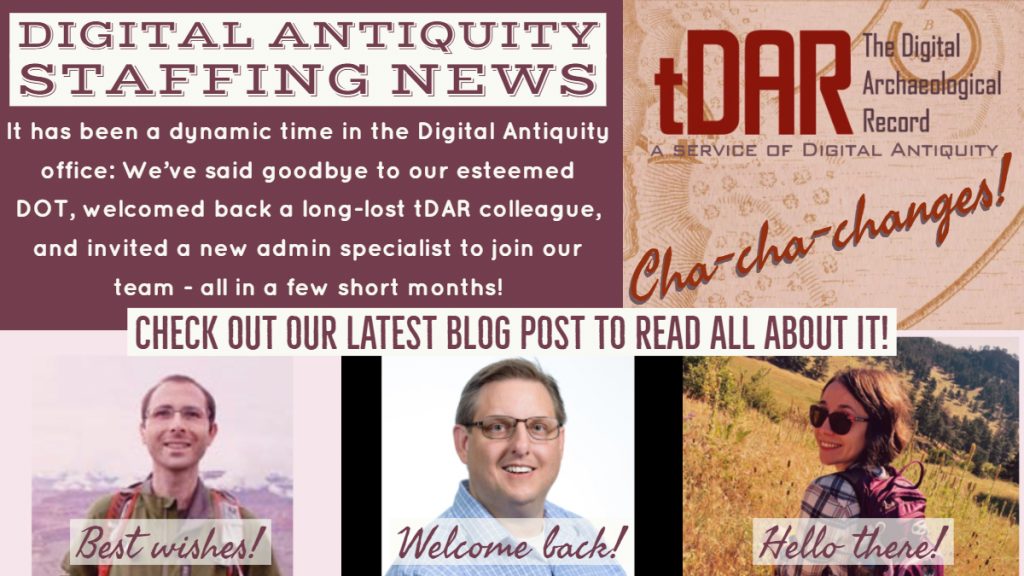
Digital
Antiquity is pleased to announce some recent staffing changes. In November 2018, our long serving Director
of Technology, Adam Brin, accepted a
new position at the Getty Museum in Los Angeles, CA. Digital Antiquity is a small team of highly
skilled people who, together, have built an amazing online repository backed by
sophisticated data management services.
None of that would have been possible without Adam’s work over the
years. We will miss him, and wish him great success in his exciting new career
with the Getty.
When one
door closes, another opens, as the saying goes.
So it is with tDAR, as we now welcome (back) Digital Software Engineer Jim deVos. Jim worked at tDAR in the early days, and now
has rejoined our team to help us move forward into our second decade. It’s an
exciting time with several new projects in the offing. Jim’s background – from
Qwest, to Honeywell, to the ASU Library and back to Digital Antiquity – brings
a wonderful mixture of skills and experience that will enable us to continue to
deliver the highest quality technical services.
Also joining
the tDAR team is Administrative Specialist Charlene
Collazzi. Charlene has a strong background
in archaeology, participating in fieldwork projects in Chile, Panama, and Egypt
on the way to earning her Bachelor’s degree in Anthropology at UCLA. Before
joining Digital Antiquity in December, she held various Administrative
positions at the UCLA Medical Center and most recently at the Boulder County
Land Use Department in Colorado. Charlene is in charge of our business
processes, manages the office, and heads up tDAR communications duties
including website and social media posts.
The 84th Annual Society for American Archaeology
meeting is just around the corner, and Digital Antiquity staff look forward to
participating in a variety of symposiums, forums, and other events throughout
the week of April 10-14, 2019 in Albuquerque, New Mexico! Digital Antiquity highlights
will include a symposium honoring the illustrious career of Keith Kintigh
(4/12), a workshop geared towards helping SAA members utilize tDAR’s digital
data curation services (4/13), and many other exciting happenings listed below.
Digital Antiquity staff will also be on hand at Exhibit Hall booth #505 throughout the
week, so be sure to stop by with any tDAR or digital curation related
questions, learn more about the SAA/Center for Digital Antiquity Good Digital
Curation Agreement, enroll in our raffles to win some great prizes, or just
stop by to say hi!
Follow us on Twitter @DigArcRec and Instagram at digitalantiquity for up-to-the-minute tDAR news throughout the conference!
Thursday, April 11, 2019
Digital Antiquity Booth
Room: Exhibit Hall in Hall 4 (ACC)
Booth #: 505
Time: 9:00 AM – 5:00 PM
Symposium: [34] Zooarchaeology and Technology: Case Studies and Applications
Room: 140 Aztec
Time: 8:00 AM – 12:00 PM
Highlight: 8:15 AM “Mapping Faunal Data to tDAR Ontologies to Address Data Comparability and Archaic Period Use of Animals in the Interior Eastern United States” —Bonnie Styles, Mona Colburn and Sarah Neusius
Electronic Symposium: [134] Towards a Standardization of Photogrammetric Methods in Archaeology: A Conversation About ‘Best Practices’ in an Emerging Methodology
Room: 10 Anasazi
Time: 6:00 PM – 8:00 PM
Highlight: Digital Curation of Photogrammetric Data —Rachel Fernandez
Friday, April 12, 2019
Digital Antiquity Booth
Room: Exhibit Hall in Hall 4 (ACC)
Booth #: 505
Time: 9:00 AM – 5:00 PM
Symposium: [188] Attention to Detail: A Pragmatic Career of Research, Mentoring, and Service, Papers In Honor of Keith Kintigh
Room: 275 Ballroom B
Time: 8:00 AM – 11:00 AM
Highlight: 10:15 AM “Promoting an Archaeological Perspective in Repatriation, Consultation, National Monuments, and Data Science —Francis McManamon
Forum: [225] From “Saving the Past for the Future” to “Saving the Future with the Past”: Building Arguments for Contemporary Relevance
Room: 220 Ruidoso
Time: 1:00 PM – 3:00 PM
Highlight: Keith Kintigh and Jeffrey Altschul, Moderators
Symposium: [237] Beyond Collections: Federal Archaeology and “New Discoveries” Under NAGPRA
Room: 130 Cimarron
Time: 1:00 PM – 3:30 PM
Highlight:3:00 PM Discussant —Francis McManamon
Symposium: [256] I Love Sherds and Parasites: A Festschrift in Honor of Pat Urban and Ed Schortman
Room: 280 Ballroom A
Time: 1:00 PM – 5:00 PM
Highlight: 2:15 PM “Lessons That Can’t Be Taught: Applying Anthropology in Honduras and Beyond” —Claire Novotny, Anna Novotny and Leigh Anne Ellison
Saturday, April 13, 2019
Digital Antiquity Booth
Room: Exhibit Hall in Hall 4 (ACC)
Booth #: 505
Time: 11:00 AM – 5:00 PM
Workshop:Using tDAR: A Workshop for SAA Members Benefiting from the SAA–Center for Digital Antiquity Good Digital Curation Agreement
Room: Enchantment C-D, Foyer
Time: 9:00 AM – 10:30 AM
Workshop Leaders: Leigh Anne Ellison and Rachel Fernandez
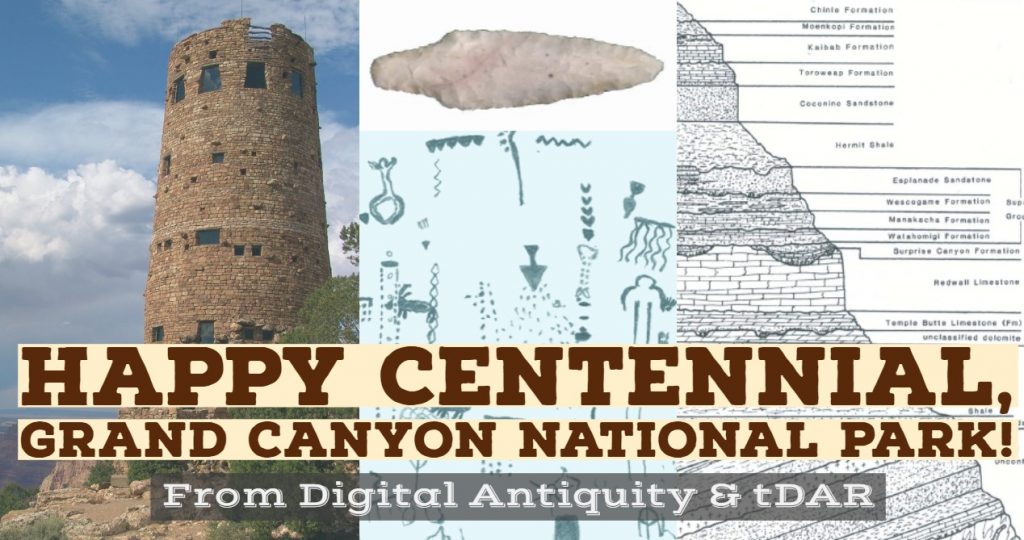
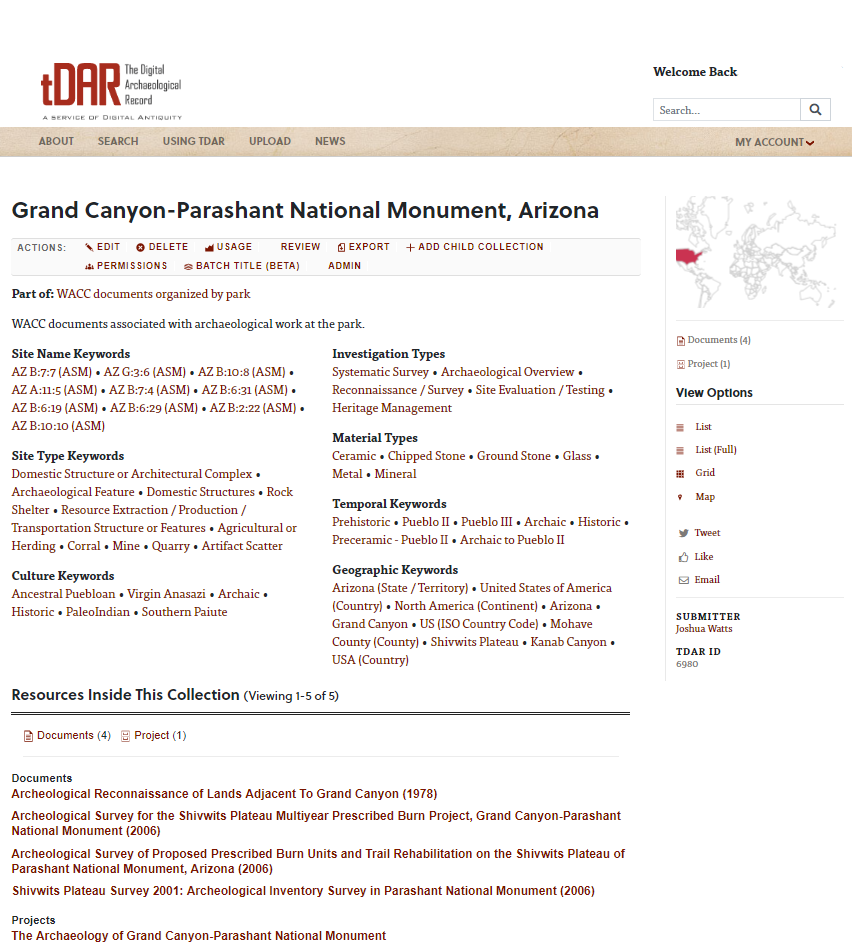
The Grand Canyon is an astonishing natural resource that has enchanted humankind for thousands of years. As evidence, this national treasure is filled with ancient and historical archaeological sites, cultural landscapes, and historic structures.
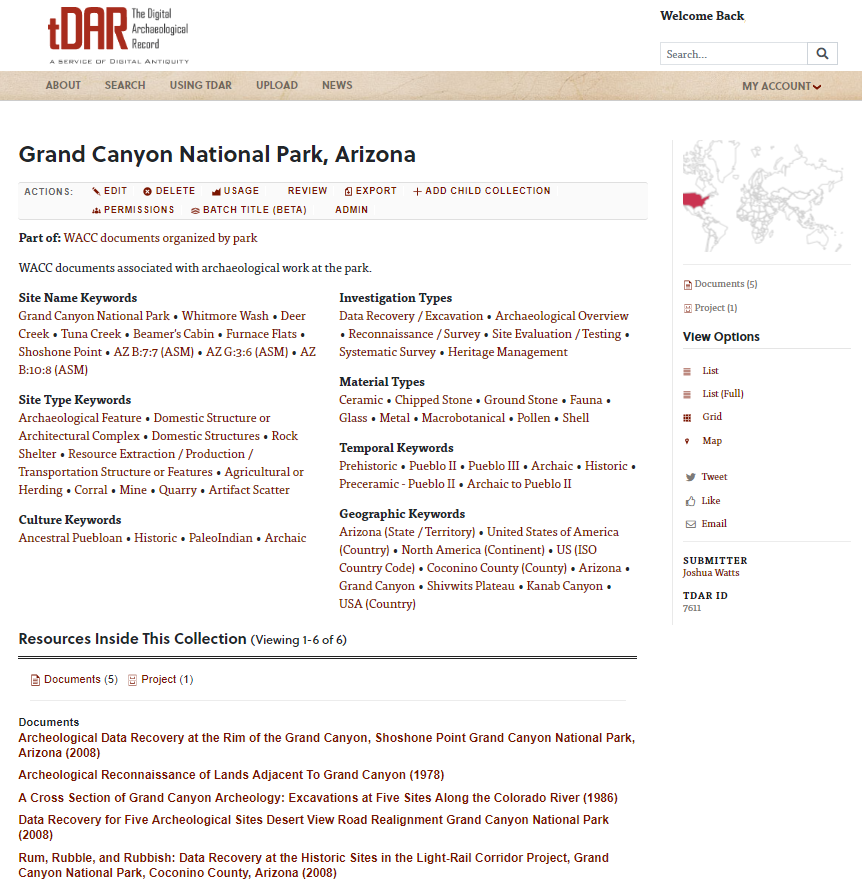
In honor of Grand Canyon National Park’s Centennial, we invite you to dig into the Grand Canyon’s near and distant past by accessing maps, photos, research, and other resources available in tDAR!
As always, tDAR’s wealth of archaeological resources are free to access and share! Register for free to learn more about the incredible cultural landscape of the Grand Canyon!
The Center for Digital Antiquity is seeking a visionary Lead Software Engineer to help develop and expand the software infrastructure and services of tDAR (the Digital Archaeological Record), a state-of-the-art international digital repository for archaeological and cultural heritage data. This is a unique opportunity to lead the technical development of innovative systems and tools for digital data management, preservation, and sustainable access to the digital repository.
This position works with the development team to design, implement, document, and support tDAR. The ideal candidate will possess knowledge of general programming paradigms and languages, full-stack development, open source data repository platforms, and experience with full-text search platforms including but not limited to: Java, Python, Ruby, PostgreSQL, Apache Solr, Fedora, DSpace, HubZero, and Dataverse. This position reports to the Center for Digital Antiquity’s Executive Director and Board of Directors.
To learn more and to apply, visit the Arizona State University employment website. Applications will be accepted through January 21, 2019.